Choose your situation.
Not sure which specialty fits? Book a first assessment: we will review your situation together and refer you to the right person.
 Tuesdays · Sébastien
Musicians & singers.
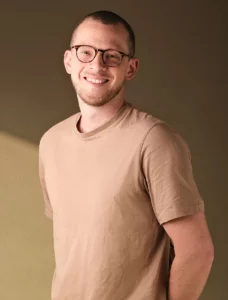
A physiotherapist and musician, Sébastien treats playing-related pain, analyses posture and movement at the instrument, and works on breathing. So you can play without pain and keep making music with peace of mind.
- Neck, back, shoulder, elbow, wrist or hand pain linked to playing
- Short breath, breath-holding while playing, a voice that tires
- Overuse, tingling, fatigue in the movement
- Prevention for young musicians, children and teens
- Getting back to playing after an injury, surgery or a long break
Tuesdays at Physio Corner, other days at KS Therapy (Geneva). Instrumentalists, singers, actors, speakers, wind players: everything is explained on the two dedicated pages.
Learn more
Why see a physiotherapist who knows music?
Musicians' pain rarely appears all at once. It builds up through the repetition of fine movements, hours of practice before a concert or an exam, and postures held for a long time. Wrist tendinitis in pianists, neck or shoulder pain in violinists and violists, guitarist's elbow, jaw and breathing issues in wind players: every instrument has its own demands.
Sébastien Braito is a physiotherapist and a musician. Trained in performing arts medicine in Lyon, and in voice at the Opéra de Lyon, he observes the body at work, instrument in hand when useful, to understand the strain before correcting it.
How does treatment work?
A first one-hour session: your history, an examination, and your playing if needed. Then a simple plan: relieve pain, restore movement, and exercises adapted to your practice so you can return to your instrument without pain. If a symptom calls for a medical opinion (persistent tingling, loss of control of a finger), we first refer you to a doctor.
Cover
With a doctor's prescription, sessions are covered by basic health insurance (LAMal). Without a prescription: first assessment (1 hour) CHF 110, follow-up sessions CHF 85.

 With Inès and Marie
Shoulder & arm.
Shoulder or elbow pain, tendinitis, sports injuries: precise, progressive care to regain strength and mobility, in daily life as in sport.
- Shoulder tendinitis (rotator cuff, biceps)
- Frozen shoulder (adhesive capsulitis), shoulder after an injury
- Pain related to osteoarthritis or an old injury
- Rehabilitation after shoulder or elbow surgery
- Strengthening and return to sport
Learn more
Shoulder pain: the most common causes
A shoulder that hurts by lifting the arm, dressing or night lying on the side, is often a tendinitis of the rotator cap or a subacromial conflict. Retractile capsulitis (« frozen shoulder ») admits to a stiffness that gradually settles and limits all movements. It evolves in several phases and requires patient and regular follow-up.
Elbow, forearm and wrist
Epicondylite (« elbow tennis ») and epitrochleitis (« elbow golf ») affect both athletes and people who work hard on computers or their hands. The treatment combines manual care, progressive loading exercises and advice to adapt everyday gestures.
Our approach
A precise assessment to identify the structure involved, then a clear progression: reduce pain, recover range of motion, strengthen the shoulder and shoulder blade, and get back to your activities, sport or work. After shoulder or elbow surgery, rehabilitation follows your surgeon's protocol.
 With Marie and Inès
After surgery.
After surgery, every movement counts, and so does the timing. Rigorous, progressive follow-up, in contact with your surgeon, so you can use your body again with comfort and confidence.
With a doctor's prescription, sessions are covered by basic health insurance (LAMal).
Learn more
Hand and wrist therapy
After carpal tunnel surgery, flexor or extensor tendon repair, a wrist fracture or a graft, the hand needs precise rehabilitation: managing swelling and pain, protecting the repair, then gradually regaining finger mobility, strength and fine motor skills. Marie specialises in post-surgical rehabilitation of the hand and upper limb and follows evidence-based protocols.
Knee and anterior cruciate ligament (ACL)
After ACL reconstruction or a meniscus injury, rehabilitation progresses in stages: regaining full extension and walking, strengthening, working on balance and proprioception, then preparing for running and a return to sport with clear criteria.
Scars and grafts
A scar can remain adherent, sensitive or limit movement. Targeted massage, soft-tissue mobilisation and self-massage advice help soften it and restore your comfort.
Hand & wrist
Carpal tunnel, tendon repair, wrist fracture, graft: regain mobility, strength and fine motor skills.
Knee & cruciate ligament
After cruciate ligament reconstruction or knee surgery: a step-by-step progression, all the way back to sport.
Scars & grafts
A scar that pulls, sticks or bothers you? Precise manual techniques, learned in a burns centre, to soften the tissue and restore your comfort.
 With Inès and Marie
Pain, injury & return to sport.
Lumbago, ankle sprain or fracture, neck, knee, long-standing pain. Relief first, then simple exercises to repeat at home, so you can get back to it with confidence.
- Dry needling : fine needles on muscle tension points
- Manual therapy and mobilisations for relief
- Proprioceptive taping to support a joint as you return to activity
- Ankle sprain or fracture : regain stable, confident footing
- Strengthening , progressive and tailored to your sport
Learn more
Back pain, lumbago, neck
Lumbago (acute low back pain) or a stiff neck can be painful but are usually harmless. Moving safely helps you recover faster. We relieve the pain with manual therapy, then give you a few simple exercises to keep it from coming back. For lasting pain (chronic low back pain, neck pain, osteoarthritis), the work is done over time, with a concrete goal.
Ankle sprain and fracture
A poorly rehabilitated ankle sprain often recurs. After the protection phase, work on weight-bearing, balance and strength restores a stable ankle for walking, running and sport. The same applies after an ankle fracture, once the bone has healed.
What is dry needling?
Dry needling uses fine sterile needles, with no substance injected, on muscle tension points (trigger points). It helps release a tight muscle and reduce pain, alongside exercise. It is always discussed and explained before being used.
Return to sport
Returning to sport after an injury means regaining strength, confidence and training load. We build your return step by step, with follow-up suited to athletes, from recreational to competitive.
 With Marie and Inès
Running clinic & foot analysis.
Understand where your running pain comes from, analyse how your foot lands, adjust your training and get back to running with confidence.
- Running pain: knee, leg, ankle, foot
- Return after an ankle sprain or fracture
- Analysis of foot strike and stride
- Advice on adjusting training and equipment
- Targeted strengthening and gradual return
Learn more
The most common running injuries
Patellofemoral pain (front of the knee), iliotibial band syndrome (outside of the knee), shin splints, Achilles tendinopathy, plantar fasciitis (pain under the heel): most running injuries come from training load that increased too quickly, foot strike that needs adjusting, or a lack of strength.
Foot strike and stride analysis
We look at your foot, how it lands and how you run, then at your training and equipment. You leave with concrete adjustments and targeted strengthening exercises.
Respecting the way you naturally move
Inès is trained in motor preferences (the Volodalen approach). Everyone has a natural way of running, standing and moving. Identifying it makes it possible to adapt your stride, posture and exercises to your profile, rather than imposing a single model.
Getting back to running
After a sprain, an ankle fracture or time off, a gradual return plan helps you enjoy running again without relapse.
 With Marie
Pilates Reformer.
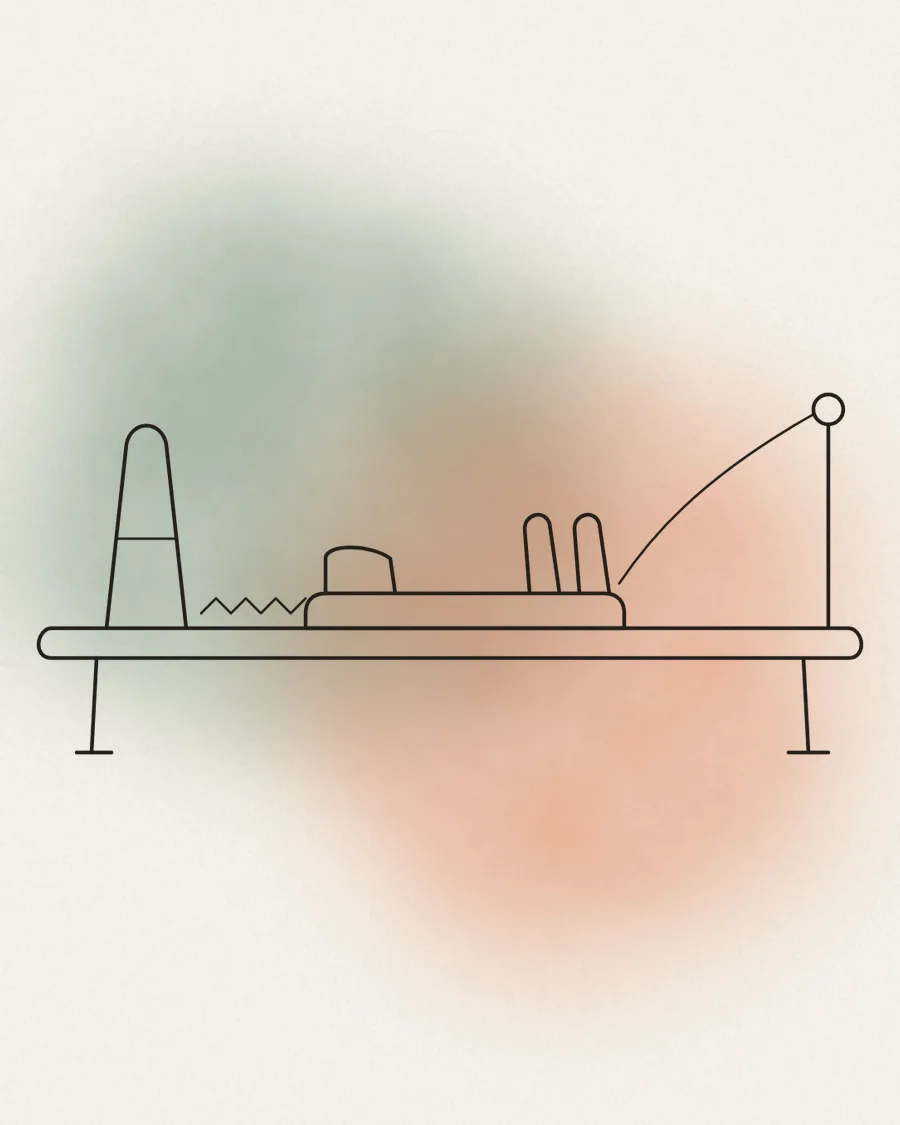
Real Pilates on a Reformer, built into your physiotherapy sessions, something few clinics offer. Its springs create a resistance that adapts completely to each person, for deep strengthening, control and mobility.
Learn more
What is Pilates Reformer?
The Reformer is a Pilates machine: a sliding carriage, springs and straps. The springs provide finely adjustable resistance, or assistance, so each exercise can be adapted to your level, your pain and your stage of rehabilitation.
Who is it for?
Back pain and low back pain, recovery after an injury or surgery, posture, deep core strength, mobility and balance, prevention for athletes and musicians: the Reformer is an excellent complement to physiotherapy. Beginner or not, everyone works at their own pace.
One-to-one or small group
One-to-one, the Reformer is part of your physiotherapy sessions, with a prescription. In a small group, on Wednesday evenings with Marie, 4 to 5 people: mat work and circuit training, to maintain your progress.
 By a rider · Inès
Riders.
Optimised posture and equipment, so you can ride with confidence. A rider for more than twenty years, Inès supports riders as true athletes, from leisure riding to competition.
- Rider pain: back, pelvis, hips
- Getting back after a fall or injury, and confidence in the saddle
- Physical preparation for the competition season
- Riding videos analysed to fine-tune the work
Learn more
The rider, an athlete in their own right
Riding loads the back, pelvis, hips and neck with every stride. Stiffness, asymmetry or an old injury can be felt in the seat and passed on to the horse. A rider for more than twenty years, Inès knows these demands from the inside.
From the clinic to the stable
A full assessment at the clinic, a questionnaire about your riding, and analysis of riding videos to link what is seen in the saddle with what is found during the examination. Trained in motor preferences, Inès takes into account the way you naturally hold yourself and move to adjust your position in the saddle. Then a concrete programme: relieve rider pain, strengthen, and gain mobility and stability.
After a fall, and for the season
Getting back after a fall or injury, regaining confidence in the saddle, or preparing physically for the competition season: the work adapts to your goals, from leisure riding to competition.
 Mondays · Aurélie
Osteopathy.
A holistic, gentle and precise approach to find the source of the imbalance. Aurélie also supports women during pregnancy and after childbirth, including pelvic floor care. Mondays at the clinic, with Aurélie Neyroud.
No prescription needed. Covered by your supplementary insurance depending on your policy, or paid privately.
Learn more
When should you see an osteopath?
Lumbago, stiff neck, back pain, tension after a sprain, a feeling of being blocked or of postural imbalance: osteopathy looks at the body as a whole to find the source of the problem, using gentle and precise manual techniques.
Pregnancy, postpartum and pelvic floor
Back or pelvic pain during pregnancy, recovery after childbirth, perineal pain and related discomfort: Aurélie offers osteopathic pelvic floor care, gently and at your own pace.
Osteopathy and physiotherapy
The two approaches complement each other. Within the clinic, we can refer you to one or the other, or combine them, depending on your situation.
In practice
Mondays at the clinic, with Aurélie Neyroud, who has more than six years of experience in emergency osteopathy. No prescription needed. Sessions are covered by your supplementary insurance depending on your policy, or paid privately.
Our advice, in a few minutes.
Short, practical advice written by the team, to help you understand your body and recover well.

