
Body decoding, our way of caring
Not a machine that does the work for you.
Body decoding is not just another technique: it is how we care for you. Understand what your body is doing, show it to you, then correct it together.
Technology analyses. Your physiotherapist interprets and guides. You feel, you adjust. It is this conscious movement that makes a correction last.
- 1AnalysePosture, muscle activity, strength: we measure instead of assuming.
- 2ShowMirror, video, live curves: what your body is doing becomes visible.
- 3CorrectYour physio guides the movement, in front of the mirror and the screen. You adjust.
- 4IntegrateThe right movement becomes second nature. The correction lasts.
Finding the real cause of pain
Relieve the symptom. Treat the root cause.
Where it hurts is not always where it starts. Our analysis looks for the real cause of the problem. We relieve first, then tackle what caused it, so it does not come back.
Relieve the symptom.
Pain, tension, stiffness, inflammation: hands-on care eases what bothers you today and brings back comfort. It is the starting point, not the end goal.
Work on the root cause.
We act on the cause we have identified: a muscle not doing its job, a movement to correct, a posture, a load that is not right. This active work makes the benefits of treatment last, without relying on passive treatments, and helps you break out of the pain cycle for good.
Our analysis tools at the practice
Every measurement answers a question.
We do not use everything, all the time. No automatic protocol: we choose the measurement that helps at the right moment. Posture one day, a muscle's activity another, strength when it is time to get back to your activities.
The tools adapt to you and to where you are in your recovery, not the other way round.
- At the assessmentVideo analysis: how the shoulder and shoulder blade move.
- During rehabilitationEMG: relearning to activate the right muscle at the right time.
- Before returning to activityMeasured strengthening: has strength come back on both sides?
01 · AI-assisted video & photo analysis
See yourself, to understand.
Often, the breakthrough is not about strength: it is about awareness. Your posture and movement are filmed or photographed, then analysed with the help of AI. What you could not feel becomes visible, and you discover it for yourself.
- Asymmetries and compensations spotted from the first assessment
- You see them on screen: that is often when everything changes
- At your instrument, in the saddle, at your desk or when running
- The same images taken again later: before and after
- AI assists, your physiotherapist decides
Large mirrors, live feedback.
Video helps you understand; the mirrors help you correct in the moment. The whole room is fitted with them: you see your movement as you make it, and your physio guides you to the right one.
02 · EMG & biofeedback
See your muscles at work, live.
EMG records your muscle activity using small sensors placed on the skin, with no needles. The curves appear live and can be compared: this is biofeedback. You see what your muscle is doing, you adjust, and the screen instantly confirms the effect of the correction.
- Right and left side on the same screen
- Before and after correcting a posture or movement
- A muscle that tenses for no reason, or switches on too late
- A target on screen: you adjust until you are in the target zone
- Learning to relax as much as to strengthen
The visual feedback of the mirror, applied inside the muscle.
03 · Measured strengthening
The right load, measured on every rep.
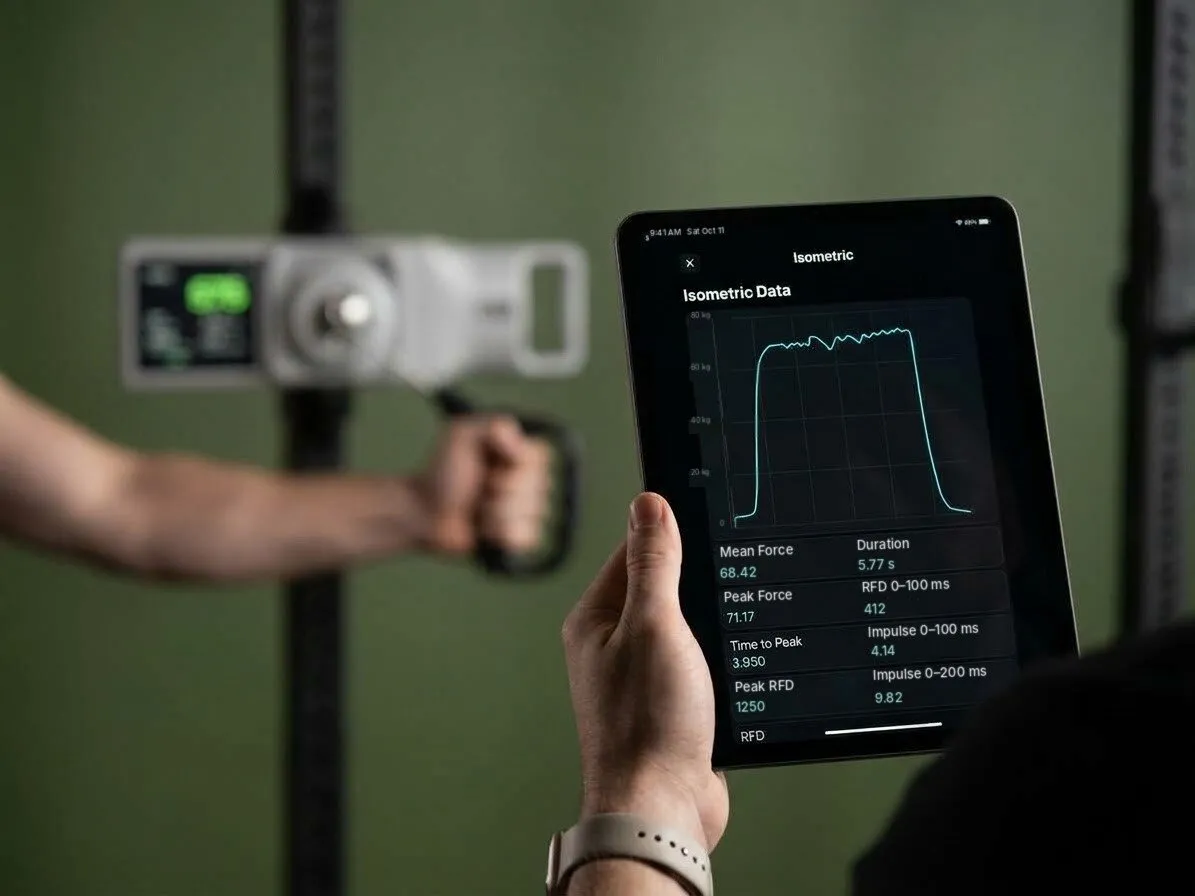
Our electronic-resistance machines set the load precisely, to match your stage of rehabilitation: gentle to control the movement, heavier for strength, faster for speed.
They do not guide the movement for you: you control it. They measure, and show everything live.
What measurement changes for you
Clear answers, not impressions.
The numbers and images tell you, session after session. Progress is motivating, and weak points are worked on first.
Because the assessment showed a specific point to work on. You know which one, and why.
Sport, instrument, work: you return when the markers are reached, not just when the calendar says so.
Ready to decode your movement?
A first assessment is enough to know where you stand and where to start.
Care that fits your real-life demands
The same complaint, two paths.
We do not approach pain the same way depending on your daily life. We are not looking for the same things, and we do not choose the same tools.
Desk work, postures held for long periods.
For people who spend their days at a desk, or a long time in the same position.
- Video
- Posture and workstation ergonomics analysis
- EMG
- Spotting and learning to release tension linked to postural stress
- Strengthening
- Upper back mobility and strengthening, at the right dose
Musicians, athletes, riders.
For people whose body serves a specific performance or passion.
- Video
- Analysis of the technical movement, at the instrument or in the saddle
- EMG
- Precise movement: the right muscle at the right time
- Strengthening
- Strength and endurance, respecting the demands of your practice

